'Who Lost Russia?'
Almost three years on ...

I originally published this review last July, exactly two years after the revised Who Lost Russia? saw print. It’s now been almost three eventful years. With Trump back in office and Ukraine on the ropes, Peter Conradi’s fictive Russia-Ukraine legendarium is unraveling even faster now than it was last summer, so I decided to jump the gun and post this on Victory Day.
On Her Majesty's secret service
In the Anglosphere, 20th-century Britain, the mother country, seems to have pioneered exploitation of ‘mainstream’ media to manipulate public opinion. The state-sponsored British Broadcasting Corporation did a lot of the heavy lifting, ironically, by spending the 20th century building public trust and a relatively dispassionate reputation. The BBC World Service reporters whom I knew in west Asia 30 years ago always strove for impartiality.
The Beeb thus helped condition several generations of Britons to accept official news as reliable. Moreover, the British government, on law-enforcement and national-security grounds, has long maintained tighter formal controls than America over just what news can be aired. Finally, my British colleagues in the late 20th century lacked the knee-jerk suspicion with which most US journalists had come to regard our own spooks, after the CIA fiascos and scandals of the Cold War.
For these and related reasons, I argue that Britain’s legacy media have been even more thoroughly captured by its intelligence agencies than America's, and for longer. Peter Conradi's Who Lost Russia? is best appreciated, then, as a skillful 435-page exercise in limited hangout. Conradi’s bio shows no sign he's ever been anything but a journalist. But in today's media ecosystem, his very job title - he's the Sunday Times' Europe editor - suggests that he must be at least spook-adjacent. His rhetorical techniques, particularly selective omission and ‘emotive conjugation,’ plainly aren't the work of an honest investigator who just got it wrong.

The dam breaks
Who Lost Russia? could never have won over hardened NATO skeptics. That's not Conradi's fault, nor was it his goal. Limited hangout targets the low-information voters who dominate western electorates. It’s a stopgap effort to avert scrutiny and maintain public support for a policy based on lies, some of which have just been unexpectedly discredited. It rarely works for long: In a fast-moving political and military environment, it’s like trying to stem a torrent roaring through a growing gap in a crumbling dam. By their nature, 'hangout' admissions are likely to contradict or undermine other talking points that remain too crucial for the regime to let go. The wary reader will spot those gaffes. The regime can only hope that there aren't a lot of wary readers. Conradi, for his part, is a clever propagandist who does his best to shore up a collapsing narrative.
Who Lost Russia? first saw print in 2017. Conradi released an updated version in July 2022, meant to cover the intervening years and the first months of open war. The passage of almost three very eventful years since then makes now the perfect time for a review: We know an awful lot today that we could only guess at in February 2022.
The Russophobe agenda
The clouds of hysteria and cognitive dissonance that choke rational thought in western capitals turn out to possess an intoxicating silver lining: Our rulers simply can't restrain themselves from blurting out the 'quiet part.' These lapses confirmed what we long suspected: In Washington, an entrenched Russophobic clique directs western policy, seeking regime change in Moscow, the overthrow of the Russian state and the breakup of the Russian Federation.
This agenda won favor long before the current war. In The Grand Chessboard (1997), Zbigniew Brzezinski floated his vision of a loose confederation of three post-Russian states - Siberia, the Russian Far East and European Russia. He didn't explain exactly how Russia would be de-federated, and he was careful to avoid harsh words like 'overthrow' and 'dismember.' But the idea was around well before that: In his memoir, former defense secretary Robert Gates recounts that in 1991, Dick Cheney - his predecessor as SecDef when the USSR broke up - was eager to go further, and break up Russia itself. As we've seen, top western officials now promote these ideas openly. The woke terminology is 'decolonization.' Among other attractive consequences, breaking up Russia would make it much easier, in theory, for western governments and corporations to access its vast energy and mineral resources.
Brzezinski also argued that without the Ukraine, Russia could never again become a great European power. He was mistaken only because he assumed that Novorossiya and Crimea would remain forever within the unnatural 1991 borders of the accidental country calling itself ‘Ukraine.’ But many within the Blob cling to this idea. Alienating the Ukraine from Moscow, then using it as a launch pad to destabilize Russia, seems to have been the plan at least since 2014, and probably long before that.
In any case, the powerful bipartisan US Russophobe clique - led by Strobe Talbott's former understudy Victoria Nuland, who after 2000 somehow became Dick Cheney's Russia adviser - won unchallenged dominance in 2021 when 'Joe Biden' was sworn in. Until January 2025, their covert plan to destroy Russia dominated US foreign policy and guided NATO. They suffered a major setback with the rise of Trump 2.0, and they face an existential catastrophe on Ukraine’s battlefields. But they haven’t yet been defanged. They remain a dire threat to Trump or any other US leader who seeks peace with Moscow – and maybe not just a political threat.
Most Americans don't grasp how little say their elected leaders have over national-security policy. Forged by military and intelligence bureaucrats, weapons manufacturers and their allies in think-tanks and in Congress, the warmongers' quest to overthrow Russia, and other projects, have been insulated from voters and seem to possess a momentum of their own. Elected officials, including presidents, can either tag along or get dragged along.
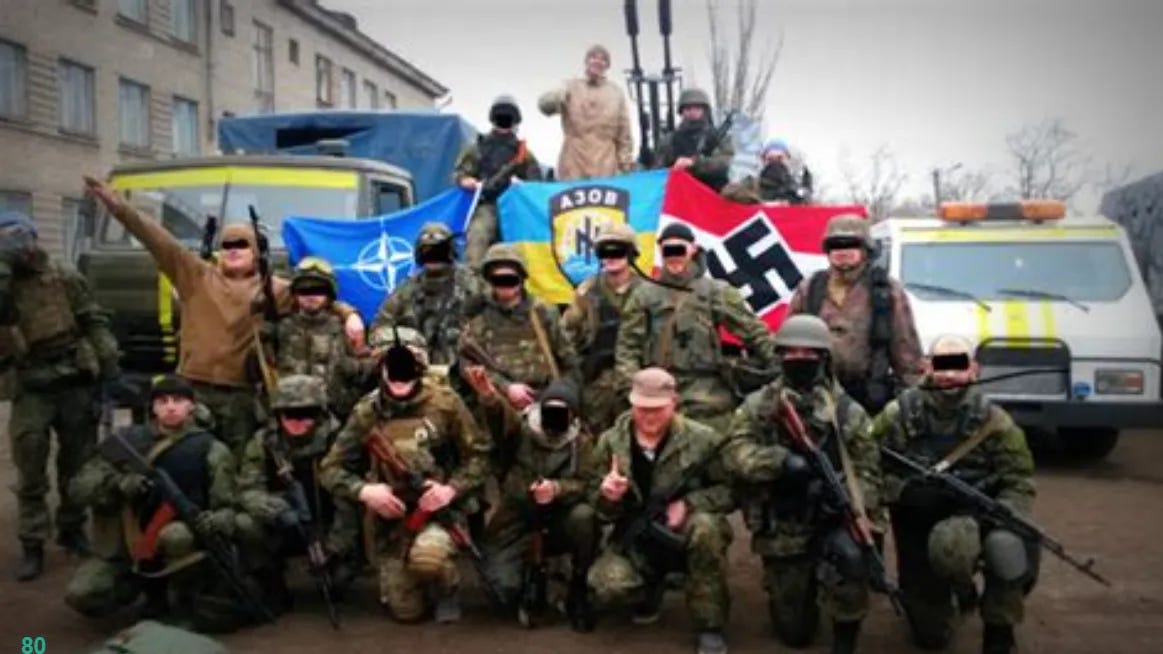
Long before the war, some of us knew the Ukraine's real authorities were Nazi militias. (Conradi, naturally, ties himself in knots trying to deny this.) A few of us even knew that what he calls North America's 'powerful Ukrainian community' wields undue influence over US foreign policy. But those too young to recall the Demjanjuk case didn't know just who the Ukrainian diaspora were or how they got here. The Canucks cleared that up just last year, feting an aged Waffen SS veteran who 'fought the Russians' for Hitler, and likely raped and murdered a great many Jews and Poles.
Of course, that’s not all we’ve learned since February 2022. I'll address new revelations as they arise, while we critique Who Lost Russia? from introduction to epilogue.
The past is another country
If you're paying attention, Who Lost Russia? blows its cover, so to speak, right there on the dust-jacket. When generalist reviewers praise any book on Russian politics as 'balanced' and 'even-handed,' all that means is, the author has convinced them he's objective - the first and most important task of any psy-op. When specialists of a certain stripe and stature weigh in - eg General (ret) Sir Richard Shirreff, who praises the book's 'startling clarity and precision,' and urges that it 'be compulsory reading for our political leadership, and the policy-makers who support them' (my emphases) - well, the cat's pretty much out of the bag.
By his own account, Conradi left Russia 'for good' in 1995. So his vaunted 'experiences in Russia a quarter of a century earlier' don't count for much: They take us through only 77 pages, to January 1994. He then skips almost two years, resuming his account in December 1995. Thus his account of events from 1996 until 2016, when he returned to Moscow to research Who Lost Russia?, relies on others' accounts and retrospective interviews. There's nothing wrong with that, it's called research. The problem is, like many media veterans of the Yeltsin years, Conradi seems to think his experiences in Russia a generation ago lent him some kind of mystical insight into a place and a people that he plainly never knew all that well, and whose fortunes and outlook changed dramatically in his absence.
It's well worth watching Tucker Carlson's recent interview with Matt Taibbi. The first forty minutes deals almost exclusively with Taibbi's experiences reporting from Russia in the 1990s. He arrived about the same time Conradi did, but stayed twice as long. He believes he was one of very few Western journalists who knew Russian well enough to work without an interpreter. He’s no 'Putin stooge,' but accuses the western press of limp-wristed coverage of the 'transition to capitalism' and of downplaying the resulting chaos and misery that gripped the country during the 1990s.
Trump derangement
'There have been no changes ... to the earlier chapters, or to the book's central argument,' ... writes Conradi in his acknowledgements. That was unfortunate. If only for protection from liability in British courts, whose defamation threshold is much lower than in the US, Conradi should have completely rewritten the chapters dealing with the Trump presidency through mid-2017. They haven't aged well, due to the collapse of the Russiagate hoax. Worse yet, the revised edition summarizes the rest of the Trump presidency in the same vein, in essence a screed of Adam Schiff talking points - debunked as thoroughly on the left as on the right. Conradi systematically misrepresents Trump's relationship with Putin, as well as the progress and conclusion of the Mueller inquiry. He makes no effort to balance anti-Trump accusations of treason with any number of eloquent rejoinders by Trump loyalists. Since we know that John Brennan & Co were feeding Schiff his talking points, and that British intelligence assets helped originate Russiagate, Conradi's partisan slant in these chapters is plainly rooted in CIA/MI6 disinformation.
Russiagate convinced a great many people Trump was a traitor in 2017, but top Democrats knew it was a hoax. Had they not, the Biden DOJ would have kept trying to find a 'smoking gun' so they could jail Trump for treason, a crime, rather than for a bookkeeping error related to a hush-money payoff, which isn't. The cool kids in media stopped talking about Russiagate because it made them look stupid, but Conradi never got the memo. This highlights another problem inherent to 'limited hangout,' especially in the internet era: Hunkered inside their silo, regime loyalists are never fully aware how much of their narrative has already been discredited by 'alternative' media. So they are always playing catch-up.
The hangout route
Notwithstanding his difficult task, Conradi is a skilled wordsmith who keeps his three-decade narrative moving along briskly. He's adept at dispassionate-sounding innuendo, leading the unwary toward the correct anti-Russian conclusion without noticing that they've been led. I recently learned that this technique has a name, 'emotive conjugation.' Wiki says Bertrand Russell first described it back in 1948: 'I am firm, you are obstinate, he is a pig-headed fool.' Better yet: ‘I’m eccentric, you’re weird, he’s quite mad.’ Conradi often dismisses Russian concerns with the rhetorical equivalent of an eye-roll or a curled lip. Russian officials are always angry, sometimes enraged. Their opponents explain or object; the Russians rail. Their every objection to western policy is a rant or tirade. Sometimes Conradi deploys sneer quotes, as with the Russian foreign ministry's concern over the all-too-real 'anti-Russian hysteria' whipped up by western spooks and stenographers like Conradi himself.
As you'd expect of limited hangout, Conradi describes long-ago events pretty fairly. The omissions and distortions arise mostly as the narrative draws closer to the present. He acknowledges some western mistakes that today are largely moot: our failure to provide humanitarian and fiscal support during the post-Soviet economic collapse. (Matt Taibbi and Jeffrey Sachs think the malfeasance was deliberate: As Taibbi put it, ‘the U.S. never wanted to lose Russia as an enemy.’) In other instances, Conradi casts still-controversial missteps, such as the disastrous expansion of NATO beyond Germany, in the best possible light. He musters articulate exponents of arguments pro and con, letting readers draw their own conclusions but leaving no doubt where British intelligence he stands.
As a result, the book's first twelve chapters, through page 175, are a lucid and reasonably fair overview of events from the final years of the Soviet Union until 2007. But even in these early chapters Conradi occasionally deploys selective omission. This always involves matters of 'original sin,' long-ago western misdeeds that, if acknowledged, would destroy the bases for present-day western policies. For example, he grudgingly admits that western leaders repeatedly promised Gorbachev that NATO would never expand east of Germany. But he justifies their treachery on the flimsy ground that they never put it in writing - even though they kind of did.
On pages 101-2, he blames the horrific consequences of economic 'shock therapy' squarely on the victims: 'The West may have provided the economic model, but it was Russia's own leaders - either out of ignorance or self-interest - who contrived to implement such ideas in an unfair way. This was especially the case with the rules governing the sell-off of state industry, which seemed calculated to help insiders at the expense of the population as a whole ... it was Russians who amassed obscene fortunes at the expense of their compatriots.'
In other words, Conradi omits the role of western financiers, and deliberately forgets that every sale involves a buyer. As American conservative writer Christopher Caldwell explained in 2017, 'The transfer of Russia's natural resources into the hands of KGB-connected Communists, who called themselves businessmen, was a tragic moment for Russia. It was also a shameful one for the West. Western political scientists provided the theft with ideological cover, presenting it as a "transition to capitalism." Western corporations, including banks, provided the financing.'
Another shortcoming of the early chapters is that Conradi focuses too heavily on national and international politics in the 1990s, and not enough on ordinary life in Russia at that time. Russians suffered terribly, for a decade, after US-backed 'reforms' wrecked their economy. That experience goes a long way toward explaining 'who lost Russia.' So this is an odd oversight, especially for someone who was there, who claims to want answers, and who insists that he's seeking them in light of his 'experiences in Russia a quarter of a century earlier.'
As Caldwell elaborated, 'You can get a better idea why [Putin] has ruled for 17 years if you remember that, within a few years of communism's fall, average life expectancy in Russia had fallen below that of Bangladesh ... [A] word can mean something different to Americans than it does to Russians. For instance, we say the Russians don't believe in democracy. But as the great journalist and historian Walter Laqueur put it, "Most Russians have come to believe that democracy was what happened in their country between 1990 and 2000, and they do not want any more of it." '
Enter the autocrat
Having introduced Putin in Chapter 9, A New Start, Conradi at first portrays him as an efficient, western-oriented technocrat and a sparing drinker - the opposite of Yeltsin. He complains vaguely of 'backtracking on human rights.' He mischaracterizes Putin's crackdown on the media outlets of rapacious western-backed oligarchs Boris Berezovsky and Vladimir Gusinsky as 'authoritarian' attacks on press freedom. But he credits Putin for economic reforms that sent growth surging, for helping US forces en route to Afghanistan, and for warning George W Bush that invading Iraq was a mistake. Conradi makes much of the two presidents' rapport, which withstood their disputes over NATO expansion and the US withdrawal from the ABM treaty, so that Washington could place allegedly defensive missiles in Romania and Poland.
Starting in chapter 13, Colour Revolutions, there's a distinct shift of both content and tone, which intensifies in Chapter 14, Munich. Many readers will be familiar with Patrick Armstrong and his Russia Observer blog. If so, you probably know that in March 2022, his first couple of Ukraine war updates so discomfited Castro’s Little Bastard that he dispatched his secret police to silence Armstrong.
So Patrick Armstrong no longer does war updates. But his website and archives are still up. His more or less weekly posts from 2007 onward are a priceless resource and powerful antidote to western media hysterics. In particular, he once memorably wrote that Western policymakers view Russia in light of longstanding memes, many of them clearly counterfactual, but whose truth nobody may question. Now, I read Who Lost Russia? so that you wouldn't have to. But if you insist, I suggest reviewing contemporaneous Russia Observer posts alongside every Conradi chapter, since it's exactly this brand of disinformation that Armstrong meant his blog to counter.
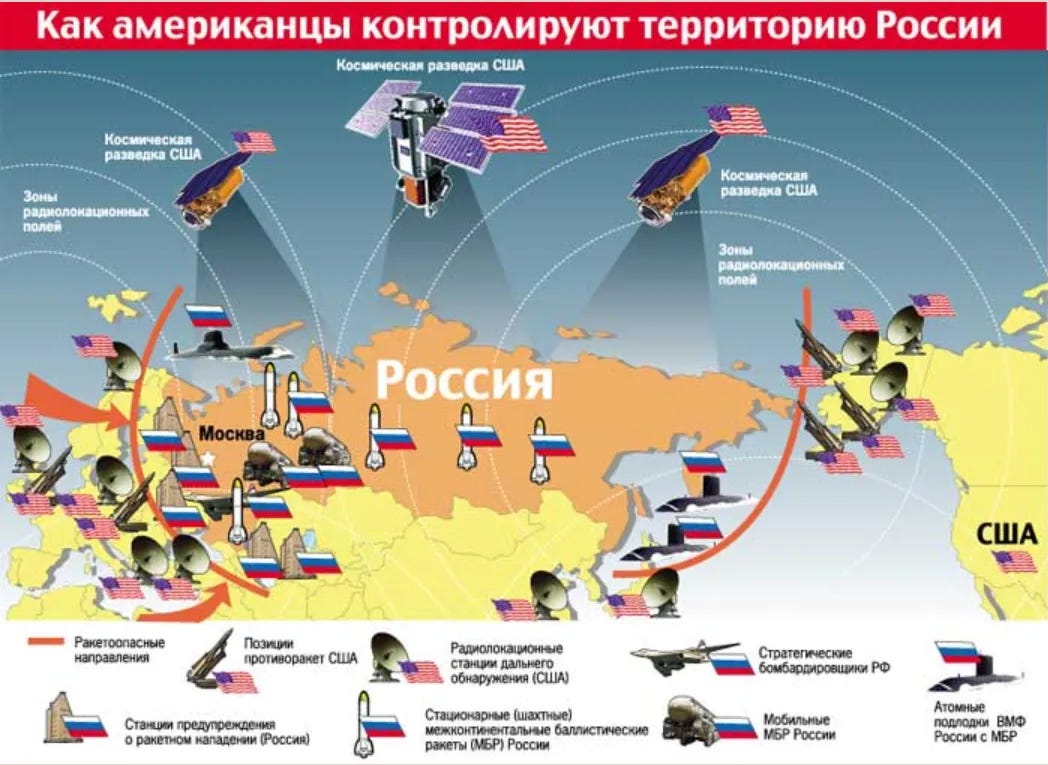
Colour Revolutions is the chapter in which memes, sketchy unsourced assertions, selective omission and emotive conjugation come together to dominate Conradi's narrative, and no wonder: The regime changes in Georgia and the Ukraine, in 2003 and 2004 - as Conradi stops just short of admitting - were covert operations engineered and financed by the US government. (This was well-covered, at the time, by media organizations that today are completely captive to the transatlantic Deep State.) Followed by an intense NATO push to induct both countries, they were the turning point that convinced the Kremlin that Washington was bent on encircling Russia with hostile US vassals, right on its borders. Russian attitudes toward the West shifted sharply as a result: In February 2007, Putin memorably warned the Munich Security Conference against America's reflexive use of military force in its quest for unchallenged domination, a 'unipolar world.'
Georgia on his mind
In summer 2008, as Conradi relates in Chapter 15, The Trap, Russia forcefully drove the point home: Mikheil Saakashvili, who'd been groomed under a US State Department fellowship to usher Georgia into NATO, sent his army against the 'frozen' separatist enclave of South Ossetia, killing dozens of Russian peacekeepers and hundreds of civilians. Moscow counterattacked and chased the US-trained Georgian Army all the way to the outskirts of Tbilisi. Conradi glosses over years of Georgian history to insist it was all Russia's fault:
' ... [Georgian president Edvard] Shevardnadze fought and won a civil war against supporters of Zviad Gamsakhurdia, a crazed if charismatic former dissident who had led Georgia to independence in 1991, and [Shevardnadze] became president in 1995. He had a turbulent time, surviving three assassination attempts and grappling with separatists in Abkhazia and South Ossetia, who were becoming bolder and angrier, egged on by Russia.' (My emphasis.)
In fact, the separatists were 'egged on' by Georgia: Conradi fails to mention that Gamsakhurdia was a Georgian chauvinist whose followers chanted 'Georgia for the Georgians.' He labeled Georgian citizens of Abkhazian and Ossetian ethnicity (along with other groups, including Muslims and ethnic Russians) 'ungrateful guests' and threats to Georgia's national identity. It was Gamsakhurdia's effort to overturn Soviet-era laws protecting minority rights and local autonomy that directly provoked the separatist uprisings. Conradi also neglects to mention that after the Rose Revolution swept Saakashvili to the presidency in 2003, he had Gamsakhurdia's memory rehabilitated and released dozens of his militants from prison. Then he renewed efforts to erase South Ossetia and Abkhazia.
Since OSCE frontline observers had forthrightly called out Georgia's aggression in the 2008 clash, Conradi prudently avoids echoing Georgian claims that the Russian started it. He instead 'hangs out' Saakashvili to dry, airing a silly trope to the effect that the Kremlin ‘lured’ him into a 'trap' in South Ossetia that he was too hot-headed to sidestep. That is, Conradi asks us to believe that Putin wanted to fight another war in the Caucasus - one that in Conradi's own words, 'threatened to draw in the West' - while Russia was still fighting in Chechnya; that Russia wanted chaos on her borders, while ethnolinguistic separatism threatened Russia's own unity; and at a time when nobody knew better than Russians that their forces weren't ready for World War 3.
More hangout in Georgia: '[T[he American government and other organisations such as the billionaire George Soros' Open Society Foundation were pouring money into fledgling Georgian non-governmental organisations opposed to Shevardnadze.'
Hangout in the Ukraine: '[A] host of Western NGOs descended ... in the run-up to the election ... Millions of dollars were pumped into the country by the US Agency for International Development ... to promote civil society, free media and awareness of democracy.'
Conradi evidently doesn't expect his readers to know that OSF and USAID are go-to conduits for regime-change cash from CIA.
Playground trash talk
It's also about halfway through Who Lost Russia? that Conradi starts outsourcing his 'even-handed' narrative to Putin's most bitter foreign foes: Mikheil Saakashvili, Dick Cheney, Hillary Clinton and Angela Merkel. Their accounts reek of cope, projection, and childish rage at having been thwarted. It's the geopolitical version of middle-school trash talk.
Saakashvili's account of his first meeting with Putin is preposterous man-child braggadocio about how he set Putin straight. (He may believe it: He's every bit as mad as his idol Gamsakhurdia.) Cheney weighs in with a clearly fictional account of Putin disrupting a politician's speech in Poland, arguing that his rudeness justified NATO expansion. Merkel whines that Putin lied to her (!) and is a homophobe. Hillary complains that Putin's body language was disrespectful, reminding us why, in 2016, tens of millions of American women held their noses and voted for Donald Trump, instead of a bourgeois postmodern feminazi.
Piled high and deeper
Chapter 19, Ukraine, is a brief respite from Conradi's rising tide of disinformation. As he describes the Maydan coup d'etat and the events that led to it, there is a lot of hangout; Conradi doesn't take sides much, and when he does, he chooses his words carefully. The only selective omission of note involves the shooting of dozens of Maydan protesters and bystanders by neo-Nazi death squads, which Conradi weakly claims were 'thought to be' carried out by the Berkut riot police. Of course, we've all known for years that Maydan militants did the shooting.
After that it's all PhD-grade disinformation: piled high and deeper. Chapter 20, A Piece of Paradise, yields predictably one-sided takes on Crimea's annexation, the secession of Donbass, Russian support for the rebels, and the downing of Flight MH17. Chapter 21, You Do It Too, delves into 'what-aboutism,' a technique Conradi claims originated with Soviet propaganda. (I never heard the term ‘til 2015 or so, when Clinton supporters began using it to deflect criticism of their candidate’s arrogance and hypocrisy.) Conradi also obsesses over the far-reaching Russian 'information war,' which nobody in the West noticed until 2016 - and then thanks only to Clintonites, again, who had begun calling anyone who disagreed with them, about anything, a 'Kremlin stooge.' I've already mentioned chapters 22-25, on Trump, where Conradi revisits Russiagate-related partisan lunacy. The Sonar 21 archive and Aaron Mate’s work are your go-to corrective resources here.
Chapter 26, Servant of the People, is Conradi's hagiography of Vladimir ‘Volodymyr’ Zelensky. He asserts that 'Putin was particularly scornful and would fatally underrate [Zelensky].' Of course Putin, we now know, wildly overestimated Zelensky: specifically the degree of agency that the puppet would be allowed by his Western masters.
Chapter 27, President For Life, is Conradi's hagiography of Western intelligence asset and fake ‘opposition leader’ Alexei Navalny. Chapter 28, America Is Back, celebrates the new president, 'Joe Biden,' who as Matt Taibbi has pointed out, was already a cognitive mess back in 2019. Conradi then cites an 'independent' 'Russian' 'news' site and unnamed 'Russian military bloggers' in falsely claiming that Russia's now-forgotten April 2021 military build-up on Ukraine's border, almost a year before the invasion, was 'unprovoked.' In fact, as Patrick Armstrong has explained, the unexpectedly swift Russian build-up wrong-footed a planned Kiev-Pentagon Donbas offensive. Conradi also fails to mention that FSB exposed a US-backed coup plot in Belarus about the same time.
The West opts for war
Chapter 29, The Road To War, describes Russian preparations and the final build-up. As Russian forces massed on Ukraine's borders and US officials howled about the ‘imminent invasion,’ Russia responded 'in the form of two draft treaties, one with NATO and the other with America, which included a list of eight security guarantees to which it wanted the West to sign up. The proposals ... included a ban on Ukraine joining NATO and a limit to the deployment of troops and weapons along the Alliance's eastern flank, effectively returning NATO forces to the point where they had been stationed in 1997, before the first round of enlargement. Russia also called for America and Russia to pull any short- or medium-range missile systems out of reach ... Ominously, Moscow said ignoring its interests would lead to a “military response” similar to the Cuban Missile Crisis of 1962 ... Western policy makers were taken aback by the extent of the proposals, which the Kremlin must have known were far from anything that would be acceptable.' (Emphasis mine.)
Conradi then quotes Dmitri Alperovitch, 'an authoritative US-based analyst,' sneering on Twitter that the 'Kremlin is not really serious’ about its demands. Alperovitch is a well-known US intelligence asset. He immigrated from Russia in 1994 as a teenager, got degrees in computer science and information security, and eventually co-founded CrowdStrike. He was the firm's chief technology officer when it echoed false US intelligence claims that the Democrat email breach of 2016 was a 'Russian hack,' rather than an inside job, as skeptics quickly ascertained.
For those who lack experience in diplomacy, with playground bullies, or even buying a used car, let me explain how this works. It's called 'negotiation.' Somebody wants you to do something (or not), and offers you something in return, a reward (or threat). In this instance you're handed a list of demands, and told 'if you do this, we won't take military action. But if you ignore our interests and refuse, we will.'
In Scenario A, you'd prefer to avoid war. So you go down the list carefully to see if you can make concessions on some, in return for your opponent dropping other demands, and renouncing military action. For example, you might offer to demilitarize the Ukraine and keep it neutral. But you bargain: You ask your opponent to let you keep some forces elsewhere in eastern Europe, to assuage local anxieties and guilt.
In Scenario B, you're spoiling for a fight. You have been for years. Your proxy is going to overrun Donbas. Crimea is toast: For years, you’ve trained the Ukrainians to carry out amphibious assaults. They’re going teach those damned Rooskies a lesson. Victory in Ukraine will carry the fighting into Russia, and in due course prompt the collapse of Putin’s fragile army and regime. Besides, you hold Lockheed Martin stock. So when you get the draft treaties, you reject them out of hand, en bloc: There’s no need for concessions, because victory is assured.
Pre-emptive bad press
Conradi's account of CIA's bizarre 'pre-emptive intelligence' campaign is just as fatuous: 'In a report on 4 December, the Washington Post, quoting unnamed US officials and citing an intelligence document it had seen, claimed the Kremlin was planning a multifront offensive as early as 2022 involving 175,000 troops ... Such leaks ... were part of a deliberate policy ... essentially revealing in public what was known about an enemy's intentions in order to dissuade them.' (My emphases.)
We’ve established it was the US that wanted war, to recapture Donbass and maybe Crimea. It didn't involve an international boundary, so Kiev would bill it as a 'police action' against 'domestic terrorists.' But the menacing Russian buildup discomfited western planners, just as it had in March 2021. They surmised Russia might intervene to stop Ukraine from overrunning Donbass - she had done so before. But they had no other insight into Kremlin or General Staff plans, because the West had zero assets at that level. The West can reliably assess only capabilities, relying heavily on high-tech surveillance and reconnaissance. Intent was a big black box.
The leaks, then, weren't 'pre-emptive intelligence,' they were a quintessentially American public-relations stunt. ‘Joe Biden’ was convinced he could bully Moscow, with a drumbeat of pre-emptive bad press, into letting Kiev seize Donbass and possibly Crimea, without intervening. This is a well-worn domestic political tactic: For decades, as the national debt exploded, Republicans occasionally mumbled about cutting entitlement-spending growth. In reply, Democrats would howl that the GOP was trying to kill grandma, 'the children' or both. In 2018 they ran a TV commercial with a Paul Ryan look-alike pushing an old woman in a wheelchair off a cliff! This performative hysteria reliably deterred the GOP from attempting serious cuts. If you can spin fiscal responsibility as elder abuse, it’s no challenge at all to portray Russian liberators in Donbass as bloodthirsty invaders.
US leaders - including, sadly, our generals and spymasters - are political hacks, not strategists. They assumed the Russians would fold like GOP politicians. They convinced themselves, Zelensky and our NATO allies that their 'pre-emptive intelligence’ leaks would intimidate Moscow. That explains a seeming paradox: 'Although Europe's leaders were privy to much of the same intelligence as Biden's administration, France and Germany were as doubtful as Zelensky that Putin would invade.' They were so doubtful, in fact, that the chief of German intelligence was in Kiev when Russia attacked, and had to be extracted by special forces. This also explains US officials’ fury and bewilderment: Despite shouting from the rooftops for months about the ‘imminent invasion,’ they had never actually believed it themselves. They kept making the accusation because they were sure it would deter the Russians. They were stunned when Russia kept its promise.
Deejay Conradi spins the hits
The final pages of The Road To War and Conradi's epilogue reminded me of a radio oldies review. Deejay Conradi plays all the western intel media hits from spring of ‘22: demoralized, hungry Russians, their tanks out of fuel; ‘captured’ ‘Russian’ ‘soldiers’ telling their ‘parents’ they 'thought they were just going on a field exercise'; fictional rapes, ‘targeted civilians,’ crudely staged ‘war crimes.’
It’s all so tiresome. It’s like when I was in junior high, back in the early ‘70s, and the record player broke: We got stuck listening to stupid pop, bubblegum and novelty hits on Top 40 radio, after we’d long since moved on to the Stones and Alice Cooper. As always, it’s what doesn’t make the playlist that matters most. Conradi doesn’t mention that Ukrainian troops abruptly intensified artillery fire along the Donbass front days before the Russians intervened, in obvious preparation for their 'police action': Nobody needs to know the Russians pre-empted a Ukrainian genocide. Nor does he mention Zelensky's Munich speech on the eve of war, when he demanded nuclear weapons. Conradi does provide a succinct summary of the CIA/MI6 media disinformation narrative that emerged in the first weeks of the invasion - a narrative nearly opposite of what took place on the ground:
'What was intended to be a Blitzkrieg to seize Kyiv, topple the Ukrainian leadership and install a puppet government soon turned into a war of attrition fought largely in the country's south and east. After two months of fighting, Russian casualties were thought to have reached fifteen thousand ... Yet Putin fought on and by the end of June 2022 his forces controlled almost 20 percent of Ukraine's territory. Hopes in the West during the first months of the war of a rapid victory for Kyiv - or even the collapse of Putin's regime - proved far too optimistic … The Russian military’s initial errors were myriad, starting with an inadequate number of forces. the two hundred thousand troops massed on [the] Ukraine’s border … were insufficient to conquer a country the size of Ukraine … Logistics also quickly proved a weak point for the Russians: tanks that had broken down or run out of fuel were abandoned by the side of the road - and then often towed away by Ukrainian tractors. Hungry soldiers were forced to loot shops for food. The Russians also failed to achieve air supremacy and made surprisingly little use of their electronic-warfare capabilities.'
In fact, as senior US Marine officers explained in the August 2022 Marine Corps Gazette, the Russians had mounted three separate campaigns, with limited objectives, none even remotely approaching outright conquest. (This is why the Russians insist on calling the invasion a ‘special military operation.’) There was a successful Russian blitzkrieg that secured a wide strip of southeastern Ukraine, along the Azov Sea coastline, as well as Zaporozhie and Kherson oblasts. That established a fortified buffer zone blocking any ground offensive toward Crimea, NATO’s strategic Holy Grail. Meanwhile, ‘In the north of Ukraine, Russian battalion tactical groups overran a great deal of territory but made no attempts to convert temporary occupation into permanent possession.’ (My emphasis). Russia dispatched BTGs to menace, not storm Kiev, and tie down troops who might otherwise attack Crimea or reinforce the heavily fortified Donbass front - where ‘Russian formations … conducted artillery-intensive assaults to capture relatively small pieces of ground.’ Russian forces seized over 20 per cent of the Ukraine's territory, not 'by the end of June,' but in a week, with a force the Ukrainians themselves admit was half the size Conradi claims, about 100,000 troops. Logistics, then, was never remotely a ‘weak point.’ Ukraine’s command-and-control capabilities were destroyed literally overnight, along with its air force and navy.
One line from Conradi’s fictive summary bears repeating: ‘Hopes in the West during the first months of the war of a rapid victory for Kyiv - or even the collapse of Putin's regime - proved far too optimistic … ‘ Keep in mind whom Conradi works for - besides the Sunday Times! This is stunning hangout. It confirms that pre-war British intelligence saw arming Ukraine as an offensive strategy to defeat Russia and force regime change in Moscow - and thought it likely to succeed.
Conradi contradicts his own claim that the Russians hadn’t achieved air supremacy, citing a Time Magazine report claiming Zelensky’s guards had fought off two assaults on their residential compound by Russian assassins who ‘parachuted’ into Kiev on the first night of war. The report is preposterous fiction: Zelensky was likely already hiding in Poland by then. But Conradi further omits mention of the helicopter assault by Russian airborne troops that seized Antonov airfield at Gostomel, video of which was all over Telegram within hours. If a successful helicopter-borne infantry assault on an airfield in the capital’s outskirts isn’t proof of ‘air supremacy,’ what is?
The tight-lipped Russians - understandably obsessed with 'op-sec' in the teeth of high-tech NATO surveillance - chose to concede the propaganda war in western media. Western spooks - by inventing a 'full-scale invasion' bent on 'total conquest' - shrugged off dramatic Russian advances as failures to meet 'objectives' that they, the western spooks, had just dreamed up. Ukrainian officials, meanwhile, were anything but tight-lipped, their wild claims bordering on manic. Improbable hoaxes - eg burned-out Ukrainian tanks and their crispy crews, repurposed as Russian - flew from Ukrainian lips to breathless western reporters' ears, 'fact-checking' utterly forgotten. Don’t forget the Ghost of Kiev! To me, the funniest episode was March 3 or 4, when Fox News kept obsessively airing CCTV footage of a Ukrainian parachute flare drifting onto the roof of an admin building at the Zaporozhye nuclear power plant, and setting it on fire. Fox claimed Russia was shelling the plant - although it was by then several kilometers behind Russian lines, on the wrong side of the mighty Dnieper River, and in zero danger of recapture.
By the beginning of April 2022, as the Istanbul peace talks bore fruit, western officials understood perfectly well that the Russians were on the cusp of victory, as the Kremlin defined it - getting Zelensky to accept a neutral, demilitarized, denazified Ukraine, with autonomy for Donbass and Crimea. Then Boris Johnson made his hasty 9 April visit to Kiev, stopping peace in its tracks. It bears repeating: Months before Who Lost Russia? went to press, western officials knew Russia was not trying to topple Zelensky, not trying to capture Kiev, nor least of all trying to overrun the Ukraine. But they were desperate to continue the war, because for them, it wasn’t about the Ukraine - it was about Russia.
Conradi’s epilogue does feature a brief, dismissive discussion, less than a full page, of the ‘realist’ view, quoting John Mearsheimer and Henry Kissinger. This shows every sign of being a hasty pre-publication afterthought. Kissinger, in May 2022, urged Zelensky to make peace and accept the pre-February territorial status quo. Conradi uses this to set Zelensky up for a trite ‘Putin = Hitler’ trope. There is no mention, of course, that a month earlier, Zelensky had been eager to accept just such a deal, until overruled by his western sponsors.
'Putin's not well'
Deejay Conradi spins one last goofy novelty tune: ‘The war against Ukraine appeared to show that a leader long regarded as a skilled tactician had finally lost his sense of reason … [I]n July 2022, it is difficult to predict the outcome of the war and the fate of Putin, himself, whose erratic belligerence … was said to have been caused by a serious illness.’
The chorus ‘Putin’s not well’ started the day of the invasion. Presenting the war as the work of an unpredictable madman was a tiresome and transparent ploy to deflect questions about how western leaders could be so stunned by an ‘imminent invasion’ they had predicted for months. The trope also aimed to distract from the obvious infirmity of the purported US president, who throughout his presidency had struggled to speak, walk and control his bowels, never mind climb stairs. Putin, by contrast, maintained his usual hectic schedule of meetings, public appearances and official travel, greeting foreign dignitaries and the like. I recall early wartime video of him literally bounding up a flight of marble steps at some ceremonial event.
Because ‘Putin’s not well’ was so unconvincing, on 21 July 2022 - just as the revised Who Lost Russia? went to press - CIA chief William Burns ‘finally had enough of it,’ noted Moon of Alabama. Burns told reporters that Putin ‘is entirely too healthy.’ The MoA post, titled ‘50 Sick Headlines About Vladimir Putin’s Health,’ is a hit parade of such reports, mostly in the British press. British intelligence, famous these days for over-the-top, improbable hoaxes, plainly was behind most of them.
The final question
‘So, who did lose Russia?’ asks the author. You won’t be shocked to learn he blames Putin. Regrettably, ‘Many Russians did indeed rally around the regime, swayed by the relentlessness of state propaganda that portrayed events in [the] Ukraine as the result of western aggression.’ This is Conradi’s coy explanation of the surge, from 70 to 80 percent, in Putin’s approval numbers after he went to war.
NATO chose to fight a third-generation war primarily with fifth-generation tactics. It had little choice: The combined West lacks the manufacturing capacity to compete with Russia and its allies at old-school industrial warfare. But NATO’s disinformation agencies erred badly in assuming that the Russian public would be as vulnerable to their psy-ops as low-information western voters have become.
Their miscalculation was on excruciating display in Kursk oblast, where last August, the Ukrainians mounted a ‘combined arms offensive’ (minus close air support, which they haven’t had since Feb 2022) a few dozen kilometers across an undefended stretch of Russian border, seizing a town of about 6,000 people and several smaller settlements. That is, when Ukrainian troops were stretched too thin to defend their rapidly crumbling Donbass positions, Kiev stretched them even thinner, sending tens of thousands - some hastily redeployed from Donbas itself - to open a new battlefront in an area of zero strategic import.
In Donbass, the Russians for two years had painstakingly fought their way forward on the flanks of heavily defended strong points like Bakhmut and Avdeevka, trapping them in ‘cauldrons’ with Russian fire control over their supply routes, eventually forcing their abandonment. They advanced incrementally, house by house, street by street, storming enemy positions with small teams of fighters only after heavy air and artillery bombardment. Though still in a sense a positional war, the Russians focused heavily on attrition: Kill as many as possible with stand-off weapons, then kill or capture any survivors, and their positions, with small teams of storm troops, so as to minimize Russian casualties. In Kursk, by contrast, the Ukrainians saved the Russians the trouble of fighting for weeks to advance along the flanks, rushing headlong into a cauldron of their own making.
Besides ‘seizing sovereign Russian territory,' they may have aimed to seize the Kursk nuclear power plant, but they never even got within artillery range. The Russians, as is their wont, spent months allowing the invaders to reinforce the Kursk salient, while methodically grinding the replacements to hamburger with drones, bombs and artillery. In April Ukrainian resistance collapsed after the Russians seized fire control of their supply lines, and the salient was overrun. The Russian defense ministry reckoned Kiev's final Kursk death toll at over 70,000 - more than all US deaths in the Vietnam war. The propaganda aspect backfired, too. Kursk convinced many Russians that the Ukraine must be destroyed as a state, leaving no remnant that NATO can exploit to mount further incursions.
Western Russophobes and their agents in mass media, like Conradi, have created an elaborate fictive legendarium, like Tolkien’s Middle Earth. Let’s call it ‘Putin’s Russia.’ It’s hard for low-information western voters to see that it’s not real. They’ve been immersed in it for decades. The propagandists have no influence in Russia, though: They ignore too many elephants in too many rooms, smashing out the windows to gorge on the shrubbery, and pooping huge fibrous turds onto the carpets. Selective omission, emotive conjugation and related tricks may fool silly westerners. But ‘Putin’s Russia’ bears no resemblance to the reality that Russians see around them.
The Russophobes can still fool western politicians - even presidents. Donald Trump returned to office swearing to end the Russia-Ukraine war in a day. It’s now been months, and the war grinds on. At least we’re talking, that’s progress. But the Russophobes plainly have great influence on Trump’s briefings. So he doesn’t grasp why Putin will agree to 3-day ceasefires, but not a 30-day one; or why a 30-day truce will result in more, not less killing. It’s not clear he’s been briefed that the entire combined West lacks the means to defeat Russia, without destroying the planet. It’s clear he thinks Russia has lost ten times as many casualties as she actually has, though some around him undoubtedly know the truth. Trump could have ended the war in a few days: All he had to do, on January 20, was cut off Ukraine arms shipments for good, pull all US government personnel out, and act forcefully to ensure that our NATO ‘allies’ did the same. The fighting would have ended almost immediately. If it ever dawns on Trump how close he was, and how easy it would have been, there might be hell to pay in the West Wing. ‘You’re fired!’
Michael Waltz actually has been fired - but not for Russophobia. Trump’s remarks that he might ‘walk away’ suggest he might someday cut Kiev off. The problem is, he didn’t do it on Jan 20. As far as we know, weapons are still in the pipeline and NATO personnel are still targeting long-range weapons strikes on Russian targets. So Trump is wide open to charges that it’s his war now. When, or if he pulls the plug, the Russophobes will insist Trump lost it.
'Gaius Baltar’ last year observed, ‘[T]he main characteristic of the current western civilization is its abandonment of reality. It is not just denial of how badly things are going, leading to delusional thinking. It is much deeper than that … The abandonment of reality is the main driving force for everything western, including economic policies, foreign relations and social policies ... [O]perating outside reality will always lead to failure and disaster. Ask any mental patient.’
This abandonment of reality is on breathtaking display in Europe. EU, British, French and German officials shout bellicose slogans as the US ponders walking away. But Europe is rapidly deindustrializing in the absence of Russian energy. She has puny armies, next to no air defense, and all her infrastructure is within range of high-precision Russian conventional missiles.
It requires a shaky grasp on reality even to entertain a question like Who Lost Russia?. Russia isn’t lost. In the real world, Russia belongs to the Russians. It’s clear where they stand. Russia was never the West’s to lose or - God forbid - to win.